

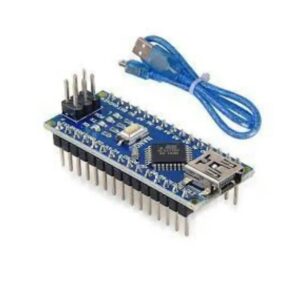
Product Overview: Arduino Nano (ATmega328P) with USB Cable
The Arduino Nano is a compact, breadboard-friendly version of the classic Arduino Uno. Despite its small footprint, it is powered by the same ATmega328P microcontroller, offering the same processing power and peripheral support as its larger sibling. It is the go-to choice for projects where space is at a premium, such as wearable electronics, small robotics, and compact IoT nodes. This kit includes a high-quality Mini-USB cable, ensuring you can power and program the board immediately out of the box.
Technical Specifications
| Feature | Specification |
| Microcontroller | ATmega328P |
| Operating Voltage | 5V |
| Input Voltage (Recommended) | 7V – 12V |
| Input Voltage (Limit) | 6V – 20V |
| Digital I/O Pins | 14 (6 provide PWM output) |
| Analog Input Pins | 8 |
| DC Current per I/O Pin | 40 mA |
| Flash Memory | 32 KB (2 KB used by bootloader) |
| SRAM / EEPROM | 2 KB / 1 KB |
| Clock Speed | 16 MHz |
| Dimensions | 18 mm x 45 mm |
Key Features
-
Breadboard Optimized: The pin headers are spaced at a standard 2.54mm (0.1″), allowing it to plug directly into any breadboard or prototype PCB without jumper wires.
-
Integrated USB Interface: Most modern Nano boards use the CH340 or FT232R USB-to-Serial chip, allowing for easy programming via the included cable.
-
More Analog Power: Features 8 analog inputs (A0–A7), providing two more than the Arduino Uno, which is ideal for sensor-heavy robotics.
-
Dual Power Sources: Can be powered via the Mini-B USB connection or an external 6-12V unregulated power supply through the VIN pin.
-
Low Profile: Small enough to be permanently embedded into custom-designed enclosures or soldered onto a 7×9 cm prototype board.


Reviews
There are no reviews yet.