
Technical Specifications
| Parameter | Specification |
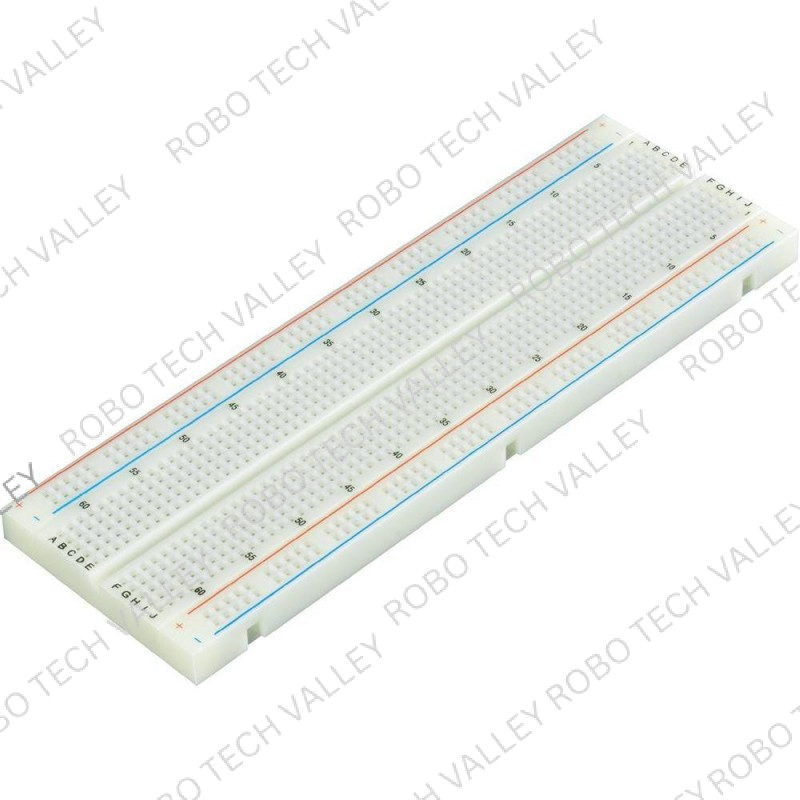
| Total Tie Points | 830 Points |
| Terminal Strip Area | 630 Points |
| Power Rails | 200 Points (4 Independent Bus Bars) |
| Dimensions | 6.5″ × 2.2″ × 0.3″ (165 × 56 × 8.5 mm) |
| Wire Compatibility | 21–26 AWG (0.4–0.7 mm diameter) |
| Material | White ABS Plastic with Phosphor Bronze Contacts |
| Mounting | Self-adhesive backing; Interlocking capability |
Understanding the Connections
Understanding the internal wiring is crucial for successful prototyping:
-
Internal Structure: Beneath the plastic housing, metal strips connect specific holes.
-
Power Rails (Horizontal): The top and bottom rows are connected horizontally. These are typically used for power (
+) and ground (-) distribution. Note: Ideally, check if the rails are split in the center or continuous. -
Terminal Strips (Vertical): The main area holes are connected vertically in columns of five.
-
The “Node” Concept:
-
Node: Any set of holes electrically connected together.
-
Making Connections: To connect “Node A” (a specific row) to “Node B” (a specific column), you bridge them using a jumper wire inserted into any hole within each respective node.
-
Why Choose This 830-Point Board?
-
Reliable Contact: Features phosphor bronze contacts with nickel plating, ensuring a tight grip on components and resistance to corrosion over time.
-
Error-Free Wiring: High-contrast printed legends and coordinates allow for faster component placement and easier troubleshooting.
-
Scalable Design: The modular sides allow you to interlock multiple breadboards, creating a massive surface area for complex robotics or CPU-building projects.
-
Stable Mounting: Equipped with a strong adhesive backing and metal plate, making it ideal for permanent installation on robot chassis or training kits.


Reviews
There are no reviews yet.